Weight and dimensions

How should I weigh a parcel for Tunisie Colis?
Weigh your parcel at home before requesting a rate. Make sure the measurement is as accurate as possible to avoid weight adjustments when it is handed over. Use household scales, or ask a shop or someone with suitable accurate scales to weigh it.
Pack the parcel properly before weighing it to avoid differences between the declared weight and the carrier’s measurement. Actual weight must include the contents, packaging and protective materials.
Tunisie Colis helps with parcel shipping, including heavy or fragile items. Although care is taken to organise delivery in suitable conditions and within the announced times, the customer must weigh the goods correctly and provide accurate information.
How should I measure a parcel for Tunisie Colis?
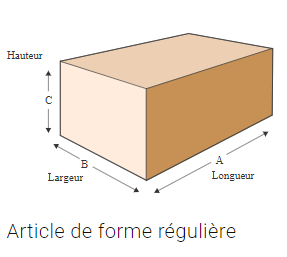
Use a tape measure or ruler to measure the parcel’s outer dimensions. Make sure your measurements are as close as possible to the actual packed dimensions.
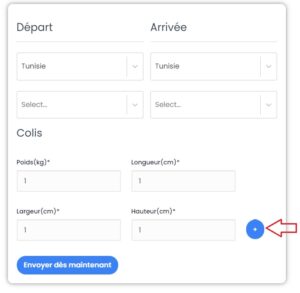
When preparing a shipment, provide the parcel’s length, width and height. If its weight or dimensions exceed those declared in the form, additional charges may apply.

What happens if my parcel exceeds its declared dimensions or weight?
The parcel’s dimensions and weight must be as accurate as possible. A courier may refuse collection if the actual parcel differs significantly from the information provided. If a discrepancy is found during transport, the carrier may hold the parcel at its premises.
If the information supplied when arranging the shipment is incorrect or differs from the carrier’s measurements, the charge may be adjusted by the difference that should have been paid initially. The goods may be held while this is resolved.
Can I combine several parcels into one?
Strapping several boxes together as one parcel is generally not recommended because it increases the risk of damage. If only one parcel is declared, only one label is generated and only that parcel appears on the carrier’s paperwork, making it difficult to prove that several pieces were handed over.
If you are sending several boxes, enter each one separately. Use the “Add a parcel” button beside the dimensions fields; the comparison accepts up to 20 parcels and prices each separately. Do not declare several separate boxes as a single parcel.
What is volumetric weight and how is it calculated?
Volumetric weight is calculated by multiplying the parcel’s length, width and height in centimetres to obtain its volume in cubic centimetres. This is divided by the carrier’s dimensional factor, commonly 5,000; some services use a different divisor, such as 6,000.
Volumetric weight formula:
Volumetric weight (kg) = length × width × height (cm) ÷ 5,000
Where the service uses volumetric weight, the shipping calculation takes it into account automatically. Accurate length, width and height measurements are therefore important for estimating the charge.
What is the maximum parcel weight?
Weight limits depend on the carrier, service and parcel dimensions. Enter your details to see the services available. Many parcel services accept up to 30 kg, but limits vary by carrier and volume; always check the specific offer’s weight, length, width and height limits.

How do I measure a parcel that is not rectangular?
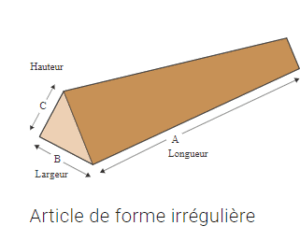
For round, L-shaped or irregular packages, use suitable protective packaging and enter the maximum length, width and height of the packed item. Accurate outer measurements help avoid adjustments or handling problems.
Was this article helpful?
- How should I pack my parcels?
- Prepare a parcel for safe shipping
- Items accepted for shipping
- Useful tips for successful delivery
- How do I change a parcel’s delivery address?
- Managing returns
- Claims service
- Customs questions
- Connecting Tunisie Colis to e-commerce platforms
- How do I contact customer service?
- Measuring parcel dimensions and weight
- Prohibited shipping items
- How does collection work?
- How do I track my parcel?
- Can I cancel my shipment?
- Payment methods
- Payment methods
- Export and import procedures
Important
Take care when packing parcels to reduce the risk of damage in transit. Good packaging also reflects your brand and professionalism to customers.
Tunisie Colis provides guidance on packing parcels. Follow these instructions when preparing a shipment. Damage caused by unsuitable packaging may not be covered by Tunisie Colis or the carrier, and compensation may not be available.
Packaging must be strong enough to protect the goods from falls, impacts, rain, leaks and other incidents during transport. Tunisie Colis is not responsible for loss or damage caused by unsuitable packaging.